


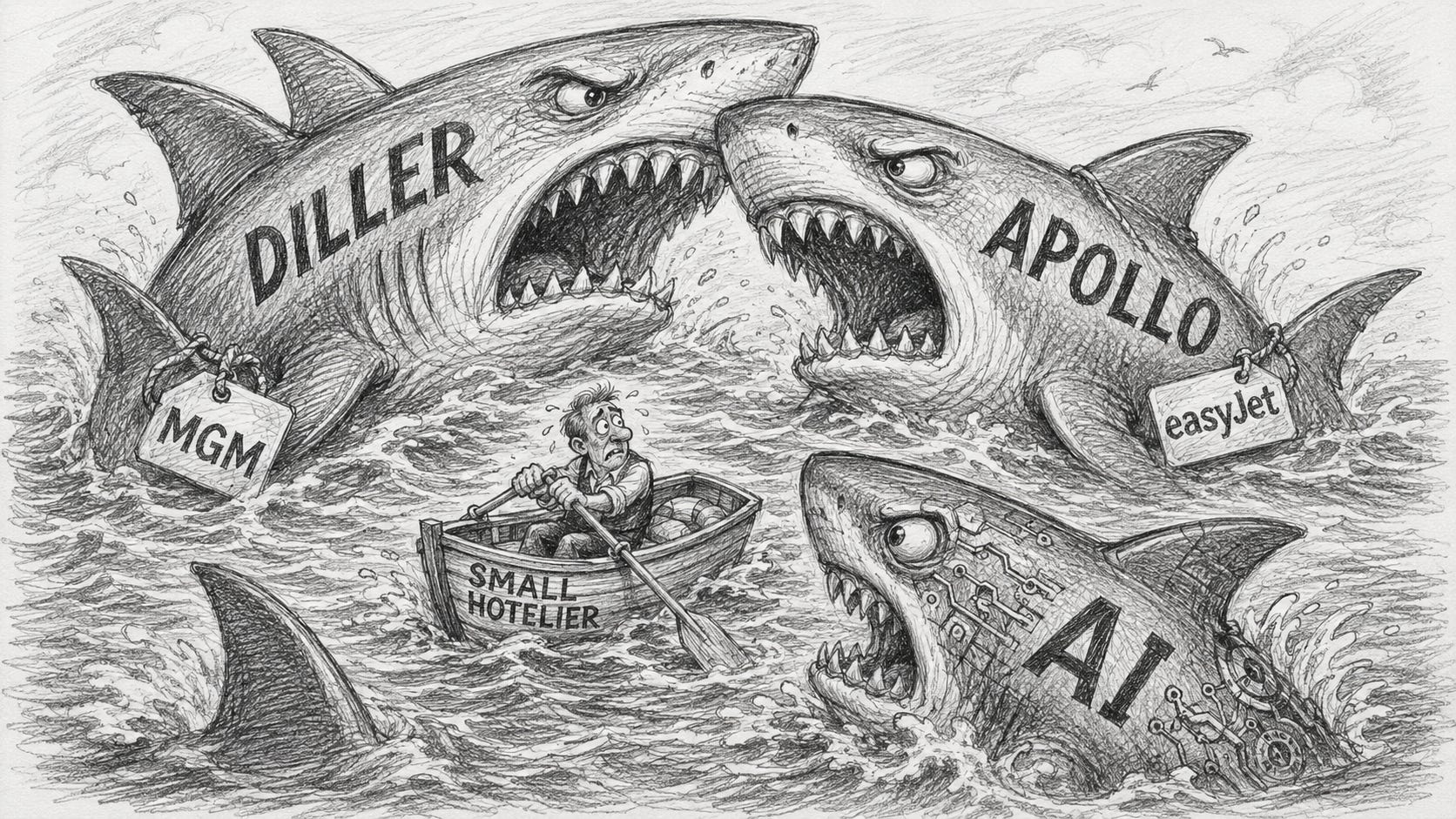
TL;DR: Too Long Didn’t Read
Hotels and short-term rentals continue blaming each other for overtourism while Motel One prepares to double in size, Booking doubles down on AI-powered trip planning, and ChatGPT agents begin carrying out real-world tasks. Industry performance remains mixed, with luxury hotels outperforming while RevPAR and occupancy soften elsewhere, despite improving development economics. Hilton and AHLA remain optimistic, but business travel sentiment weakens as costs and administrative burdens rise. New research suggests hospitality REITs closely follow overall market performance, while this week’s practical resources focus on distribution, digital accessibility, hiring, budgeting, cybersecurity, and the growing role of AI in hotel operations.
0. News Snippets
Leonardo Hotels’ owner, the Fattal group, is finally stepping into the US market.
Booking is quietly scaling the machine that wholesales your rooms, in case you weren’t paying attention.
Airbnb and UK councils have teamed up on data-sharing to catch illegal social housing sublets.
Turns out Americans aren’t cancelling summer, they’re just “reimagining” it.
0.5 Follow Up
Booking’s bad week gets an Italian chapter
Fresh off a £2 billion UK consumer claim, Italy’s Antitrust Authority has opened its own probe into Booking.com. When the regulators and the guests and the hoteliers are all lining up at once, you start to wonder who’s left defending the parity clause.
1. Big Players
MGM forms a committee to say no thanks
Barry Diller already owns 26.1% of MGM and wants the rest, offering $18 billion including debt. MGM’s response: form a committee, hire advisors, and quietly suggest the offer is cheap. Fair - the CFO himself admitted the domestic business trades at “a very low multiple,” and has for a while. Diller’s bid landed days after Fertitta agreed to buy Caesars for $17.6 billion, so apparently casino operators are having a moment. No deal guaranteed. Meanwhile your night audit still doesn’t balance.
Buy the operations, skip the bricks.
Scandic’s paying €500 million for Dalata’s operations - 56 hotels, 12,000 rooms across Ireland and the U.K. - while Pandox and Eiendomsspar quietly own the actual buildings from their €1.6 billion deal in November. Net debt at Scandic? 0.1 times earnings, basically nothing. So while you’re financing a roof replacement out of pocket, Scandic is out here running someone else’s real estate on a management contract and calling it growth. Trade below the value of your own bricks and apparently this is what happens next.
Omio buys Rail Europe, a brand founded in the 1930s
Omio just scooped up Rail Europe, the 1930s-born ticket distributor that’s been through more owners than a boutique hotel in a recession. Financial terms undisclosed, because of course. Omio also grabbed $10M from Granite-Integral to chase Japan and Southeast Asia - right after launching there in March. End result: 22 million train tickets a year, 28,000 operators, and one more B2B middleman consolidating the ground transport chaos you already can’t fully see commission on.
MakeMyTrip Wants an India Homecoming
MakeMyTrip, already trading in the U.S., is reportedly about to confidentially file for an India IPO worth over $1 billion - potentially the biggest travel listing the country has ever seen. Four banks (Kotak Mahindra, Axis, JP Morgan, Morgan Stanley) are lined up to advise. The company won’t confirm timing, but it’s been telegraphing this since a May SEC filing. Nothing says confidence like listing twice - once wasn’t enough validation, apparently.
Delta Proves Premium Beats a Fuel Bill
Fuel prices spiked, and Delta’s operating margin only dropped four points instead of collapsing entirely - 9% margin, beating its own April guidance. The trick? A premium-heavy revenue base that eats cost inflation for breakfast. Sound familiar? It’s the same logic behind every resort fee and suite upsell you’ve ever pushed. Delta’s now taking it further with a stripped-down Basic Business fare, while Air India and IndiGo run their own budget experiments. Unbundle the cheap stuff, protect the margin on the top end - works for planes, works for rooms.
Marriott spends $1B to reinvent the wheel
1,700 hotels down, the rest of the globe to go over the next 18 months, and Marriott’s finally retiring a property management system older than most of its GMs - 42 years old, for the record. The payoff: guests can book that specific corner room, a crib, a tee time and a spa slot in one cart. Meanwhile Marriott says AI hasn’t moved actual booking traffic yet, but they’re watching - right around the time you’re still explaining to a guest why housekeeping can’t find their crib.
Now Guests Sue Booking Too
A former CMA lawyer is coming for Booking.com with a £2 billion opt-out claim, backed by litigation funder Balance Legal Capital, on behalf of millions of UK consumers who allegedly overpaid thanks to price parity clauses. Hotels have been suing over parity for years in France, Spain, and via the Bed & Breakfast Association - now it’s the guests’ turn to say they got fleeced too. Booking.com built an empire on the rule that you couldn’t sell rooms cheaper anywhere else. Turns out both sides of that transaction want their money back.
Airlines Discover Rich People Like Nice Seats
American, Delta and United are pouring billions into suites, lounges and Wi-Fi because it turns out premium flyers pay real money. American admits it’s playing catch-up, retrofitting 777s while a mattress pad and privacy door become table stakes. Delta’s defending its crown with new Airbus A350 suites in 2027. United’s Scott Kirby just wants everyone to love United the way they love Delta. Meanwhile you’re still comping a room because the Wi-Fi crashed - must be nice to have a industry where the fix is Starlink and a nicer pillow.
Someone wants to buy a hostel chain
Infill Capital Partners is circling Safestay with a possible £40.9m take-private, funnelled through something called Lume HoldCo - because nothing says hostel acquisition like a Luxembourg shell name. No firm offer yet, just “limited due diligence,” cash-or-shares maybe-talk, and a deadline of 5pm on 7 August 2026 to fish or cut bait under the Takeover Code. Safestay’s advice to shareholders: do nothing. Bold strategy for a company that just triggered an official offer period.
OTAs Do Math That Somehow Favors OTAs
The Virgin Islands just did the arithmetic Priceline, Expedia, Orbitz and Hotels.com hoped nobody would: a $100 room taxed at 12.5% owes $12.50. They collect that from your guest, remit $7.50 based on the $60 wholesale rate, and pocket the rest. BIR says some no-show reservations got zero tax remitted at all, and the bundled “taxes and fees” line exists specifically to hide the gap. Now they’re being sued for unjust enrichment and breach of fiduciary duty. Meanwhile you’re still explaining to guests why the resort fee isn’t a resort fee.
Fora hits $1 billion, no experience required
Fora just raised $60 million at a $1 billion valuation, proving “host agency” isn’t code for your aunt who books cruises anymore. Of its 15,000 advisors, 97% had never sold travel before signing up -3 yet the network has booked $3 billion total, adding the last billion in just five months. Backers include comedian Amy Schumer’s investment collective, because nothing screams travel-industry credibility like a stand-up special. The money funds Via, an AI assistant meant to strip admin work off advisors’ plates, plus expansion into cruise and air. Untrained enthusiasm scales fine when a bot does the paperwork.
2. Travel Tech
Mews Automates Itself Out of 170 Jobs
Mews just laid off 15% of its workforce - about 170 people - months after raising $300 million at a $2.5 billion valuation. Founder Richard Valtr says AI now handles financial services, revenue management and procurement “more profitably” than hotels have managed themselves, and he’d rather cut now than wait for the landscape to change “irreversibly.” Customer-facing roles were spared, 36 jobs remain open. So the PMS vendor building your AI-native future just proved the economics on its own payroll first. Reassuring, or ominous? You decide.
Google Yourself. You Won’t Like It.
600,000 Google ads in North America alone now bid on hotel brand names - sites dressed up as you, waiting for guests who already decided to stay with you. You created the demand, a predatory OTA collects the commission, and when the guest gets stung by fees you never set, they blame you, not the fake listing. Hoteliers filed this under “unwinnable” for two decades. Turns out it wasn’t small and it wasn’t unbeatable - just unmonitored. Search your own name tonight, on a phone that isn’t yours, and see what’s sitting above your website.
3. Industry Trends
Malaga says no more automatic yeses
12,000 short-term rentals, 64,000 beds, and Malaga City Council has decided that’s plenty. New hotels, hostels, tourist apartments and STRs on residential land now need a full planning modification - no more rubber-stamping, and developers must prove their project actually benefits the neighbourhood. Applications filed after this kicks in could sit in a three-year suspension, on top of the existing moratorium already covering 43 saturated neighbourhoods. Marbella, meanwhile, is still waving new licences through and Manilva’s just pausing. Nice to see the Costa del Sol united in strategy, as always.
ETIAS Delayed Because EES Is Still on Fire
EU-Lisa admits ETIAS won’t launch this year after all - the FT says 2027 now, despite the website still promising Q4 2026. Reason: EES is such a mess at the borders that adding a second €20 authorisation system on top would, in the words of one official, “double the line again.” So the queue chaos your guests complained about all summer stays exactly as is, just without a sequel. Silver lining: you get another year before explaining ETIAS to confused Americans at check-in.
German Hotels Worth More, Barely
Germany’s hotel property market hit €66.1 billion in 2025, the highest since before the pandemic - up 2.8% from €64.3 billion. Don’t get too excited about your own building though: existing hotels only gained 0.5% in value, while nearly 10,000 freshly built rooms did the actual heavy lifting. Overnight stays hit a record 497.5 million, so it’s not a demand problem. A third of new rooms came from conversions - old office buildings and villas turned hotel, because apparently repurposing beats building from scratch. Transactions jumped a third to €1.9 billion. Congratulations, you’re worth more, on paper.
Luxury hotels win the World Cup, again
US RevPAR jumped 8.7% in June, and luxury properties grabbed 16% of it while everyone below midscale watched from the parking lot. FIFA host cities ran 13% growth versus 7% elsewhere, so if your property isn’t near a stadium, thanks for playing. Macquarie’s favorite is Hyatt, 68% exposed to luxury and upper upscale versus Marriott’s 52% and Hilton’s 28% - proof that owning the penthouse beats owning the most rooms. Meanwhile Marriott and Hilton guided 2-3% for the year. Oops.
Guests Happier While Paying More
JD Power says hotel satisfaction jumped 13 points to 665 out of 1,000 in 2026, even as rates climbed - with perceived value up 18 points. Front desk courtesy, faster request handling, and cleaner pools apparently buy a lot of goodwill. Also new this year: Gen Y and Gen Z are quietly letting AI pick their hotels for them, 49% and 23% of AI users respectively. And the real amenity war isn’t the rooftop bar anymore - it’s daily housekeeping and filtered water stations. Write that on the reno budget before the smart TV upgrade.
Cyprus checks its licences, finds almost none
A building collapsed in Germasogeia with three unlicensed apartments inside, so naturally Cyprus audited its paperwork. Turns out only 30% of sampled self-catering listings actually match the registry - the rest are ghosts, typos, or borrowed licence numbers. But don’t smirk too hard, hoteliers: of 728 licensed hotels and tourist accommodations, just 23% hold a full operating licence, 22% limp along on temporary status, and 55% operate with nothing at all. Everyone’s illegal together - truly the unity the industry needed.
4. Externalities
Minor Hotels found Oman and Africa to be its safe havens during the Iran war.
Airlines are tiptoeing back into Middle East routes, very slowly.
Israel’s tourism ministry is making its pitch to entice visitors back.
Flying soon? Aviation authorities warn you to keep power banks out of checked luggage.
Another week where the buildings stay where they are and everyone else trades the paper on top of them. Search your own name tonight - then go find your night auditor.